









For some time now, I have been working on analysing hotel reviews and providing data for The Guest Experience Benchmark Report. It is the most comprehensive report in the world of guest experience, more precisely how guests are rating their experiences in hotels. The 2023 edition marks a significant milestone, offering insights into the complex world of guest satisfaction during a time of significant change in the industry.
The 2023 Guest Experience Benchmark Report includes:
- A high-level summary of key review metrics.
- A detailed analysis of review data at the global level and for 6 geographic regions.
- City rankings for 18 cities.
- City Benchmark for 71 cities and Destination Benchmark featuring Global Review Index™ (GRI) scores for a selection of 10 of the world’s most popular resort destinations.
- Insights and strategies supported by key metrics and recommendations for improving online reputation in 2024, in light of the most recent trends.
Behind the scenes of building the report
In early 2022, I was approached to contribute to crafting a new Global Report. Diving into the wealth of data our tools extract from online reviews, I was reminded of a powerful sentiment expressed by JFK in 1962: “The more our knowledge increases, the more our ignorance unfolds.” This project struck me as a golden opportunity not just to display our vast datasets but to guide and shed light on emerging trends within the hospitality sector.
Drawing on my background as a Product Specialist and extensive interactions with over 600 clients and prospects over the last two years, I considered this report a vital tool. My role has largely revolved around analysing customer reviews and helping clients decipher complex data. Despite some data points’ challenges, I’ve always aimed to simplify these insights, allowing clients to understand their metrics better.

The Guest Experience Benchmark Report, I believe, offers a broader perspective, enabling hotels to benchmark their performance effectively—a resource many had been eagerly seeking in order to assess their standings accurately.
The notion of “information” is predicated on the uniqueness of “new data,” asserting that only previously undisclosed or unshared data qualifies as information. Thus, our objective with this report was to cast these familiar data points in a new light, offering hoteliers a fresh perspective on the dynamics shaping the industry today.
Let’s delve deeper into the insights and discoveries that lie within, encouraging a reevaluation of what we know, or think we know, about guest satisfaction and performance metrics in the rapidly evolving hotel industry.
A Mixed Bag of Recovery and Realignment
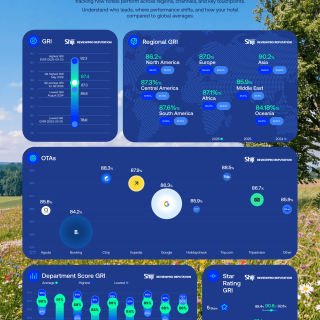
The industry has shown resilience and adaptation during the pandemic. The 2023 report analysed over 48 million reviews from 60 different sites in 68 languages, revealing a recovering industry still facing pandemic-related challenges.
Review volumes grew by 19.1% over 2022, but the Global Review Index (GRI) did not surpass its 2019 levels, falling short by 0.9 points. This shows the industry’s resilience and guests’ changing expectations, reflecting a landscape forever impacted by the pandemic.
German Chancellor Otto Von Bismarck once said, “Man cannot control the current state of events. He can only float with them and steer.” This quote is relevant to the post-pandemic phase as it shifted market share. Booking.com experienced substantial growth in its market share during this time.
In 2022, the online travel agency led all other review sources by 20 percentage points in terms of generated reviews. However, in 2023, the company’s growth slowed, losing more than 7 percentage points over the previous year.
The report also highlights significant shifts in market share among online travel agencies (OTAs), with Booking.com’s dominance waning slightly in 2023. This recalibration reflects a broader industry trend towards diversification and resilience.
North America and Asia-Pacific in Focus
North America’s market showed a decline in guest perceptions of quality, especially regarding room quality. In contrast, the Asia-Pacific region nearly matched its 2019 GRI levels, indicating fierce competition and an ongoing pursuit of excellence, particularly in the luxury segment.
These regional differences highlight the diverse challenges faced by hoteliers worldwide and underscore the importance of localised strategies in enhancing guest experiences. The evolving dynamics of the North American and Asia-Pacific markets offer valuable lessons in adaptability, and the critical role quality plays in securing guest satisfaction.

The Rise of Review Response Efficiency
Among the most heartening trends identified in the report is the significant increase in the proportion of reviews that hotels have responded to, coupled with a decrease in average response time. This trend signifies a growing recognition of the importance of engagement and the role of feedback in continuous improvement. Adopting automation tools in managing review responses indicates an industry increasingly leaning on technology to enhance guest experiences.
This shift towards more efficient and timely engagement with guests is a positive development, pointing towards a more responsive and guest-centric industry. The role of technology, particularly automation, in facilitating this shift cannot be overstated. As the industry continues to embrace digital tools, the potential for improving guest experiences is immense.
Key takeaways:
Recovery Yet to Surpass 2019: Despite a strong recovery in review volume in 2023, the Global Review Index (GRI) remained just below the 2019 level, highlighting a near-complete but not fully realised recovery.
Market Share Dynamics: Booking.com’s dominant market share decreased in 2023, indicating a shift in the competitive landscape of online travel agencies.
Regional Variations: North America struggled with guest perceptions, especially concerning room quality, while the Asia-Pacific market nearly matched its 2019 GRI levels, showcasing resilience and competitive strength in the luxury segment.
Increased Engagement: Hotels have significantly improved in responding to reviews, both in terms of the percentage of reviews answered and the speed of responses, demonstrating a more proactive engagement with guests.
Future Trends: The report suggests potential future trends, including the differential recovery pace between hotel categories, the sustained positive trend in the Asia-Pacific market, and the impact of automation in managing and responding to reviews.
Future Trends and Implications
During last year’s peak season, the European market’s struggle led to a noticeable shift towards September shoulder season stays. Should this trend persist into 2024, it could significantly reshape guest experiences and satisfaction levels. The move away from traditional peak travel times signals a desire for less crowded, potentially more authentic travel experiences.
This shift challenges the status quo and presents an opportunity for the industry to innovate and cater to evolving consumer preferences. I believe that adapting to these changes is crucial for enhancing guest satisfaction and redefining the European travel experience in the coming years.
The differing recovery rates between 3-star and 5-star hotels, with the latter rebounding stronger, highlight a growing divide in the hospitality market. This trend may prompt a strategic reassessment to address evolving consumer behaviours and market demands, especially for mid-range hotels.
The Asia-Pacific region’s robust recovery in 2023 raises questions about its sustainability. This underscores the importance of strategic planning in regional markets to maintain momentum.
Review source dynamics, particularly the post-pandemic market share shifts, pose challenges and opportunities in reputation management. A potential return to a pre-pandemic distribution of review sources requires strategic adjustments in customer engagement.
The rise of automation in managing customer reviews marks a pivotal evolution in hospitality management. It aims for efficiency in feedback management. However, it also calls for a balance between automation and personalised guest experiences.
These trends and developments hint at a period of significant transformation and opportunity within the hospitality industry. The sector’s ability to adapt to these changes, leveraging technology while maintaining the essence of personalised guest experiences, will likely define its success in the coming years.
Conclusion
The 2023 Guest Experience Benchmark Report paints a picture of an industry at a crossroads. While the shadows of the past linger, the data and trends highlighted in the report illuminate the paths to recovery and growth. As demonstrated by its recovery and adaptation efforts, the hotel sector’s resilience offers a hopeful vision for the future.
The report’s findings underscore the importance of continuous adaptation, localised strategies, and embracing technology in navigating the post-pandemic landscape. As we move forward, the lessons drawn from this comprehensive analysis will undoubtedly serve as a compass for industry stakeholders, guiding strategic decisions and operational priorities.
Reflecting on the journey thus far and the road ahead, JFK’s words resonate deeply within the context of our industry. The 2023 Guest Experience Benchmark Report not only expands our knowledge of the current state of the hotel industry but also invites us to explore the unknowns.
In essence, the report is more than just a collection of data; it is a call to action. For those keen on steering their establishments toward unparalleled excellence, this report is not just recommended reading—it’s an indispensable guide for the year ahead.
- How to Start a PMS Migration: 6 Steps Before You Change Systems
- Hotel Software Is Learning to Understand Intent
- AI Won’t Replace Hospitality. It Might Save It.
- Hotel PMS Migration Is Really an Exercise in Operational Discovery
- The Hidden Link Between Guest Data, POS Intelligence, and Restaurant Profitability


